Tampilkan postingan dengan label CABBAGE. Tampilkan semua postingan

Vegan Moo Shu Vegetables With Tempeh

Mei 25, 2016 0
Simple and delicious Moo Shu Veggies - great for entertaining!

Follow Foods For Long Life on Facebook and Pinterest.

Moo Shu
Moo Shu (fill in the blank) is a popular dish in Chinese restaurants. You can order Moo Shu pork, chicken, shrimp, tofu, and vegetables. They usually are made with shredded cabbage, onions, mushrooms, scrambled eggs, and seasonings, and are served on a delicate pancake which almost always breaks apart in your hand half way through eating it. The characteristic flavor is usually dominated by the yummy plum sauce that it is served with.

Most of us wouldn't think of making this at home, probably because of the difficulty of making the pancakes. But if you take that fear away by using your favorite tortilla as a replacement, the rest of the job is pretty easy! Just stir up a few veggies, buy some plum sauce at your local market, and you're almost there.

Today's recipe uses Three Grain organic tempeh from Lightlife as the protein made from cultured soybeans plus millet, brown rice, and barley. It's a great source of iron, protein, and dietary fiber. Feel free to use other types of tempeh made from other grain combinations. For extra flavor, try using marinated tempeh in flavors such as sesame garlic, or teriyaki.

One 3 ounce serving has:
170 calories
5 g total fat, 1 g saturated fat
6 g dietary fiber
16 g protein
14 g carbohydrate
10 mg sodium
15% DV of iron

         *                               *                               *


Moo Shu Vegetables with Tempeh
Vegan
[makes 6 servings]

Ingredients
4 teaspons sesame oil, divided
4 ounces organic tempeh, thinly sliced
1 tablespoon fresh minced ginger
2 cloves garlic, minced
1 onion, thinly sliced (about 1 1/2 cups)
6 cups thinly sliced cabbage
1 large carrot, shredded or cut into ribbons
1/4 pound fresh shiitake mushrooms, stems removed and thinly sliced
1 1/2 tablespoon soy sauce
1 1/2 tablespoon rice vinegar
6 tortillas
2 tablespoons plum sauce 

Cabbage, onions, carrots, and shiitake mushrooms

Directions
Heat 2 teaspoons of the sesame oil in a non-stick pan on medium heat. Add the sliced tempeh and cook until browned, a minute or two per side.
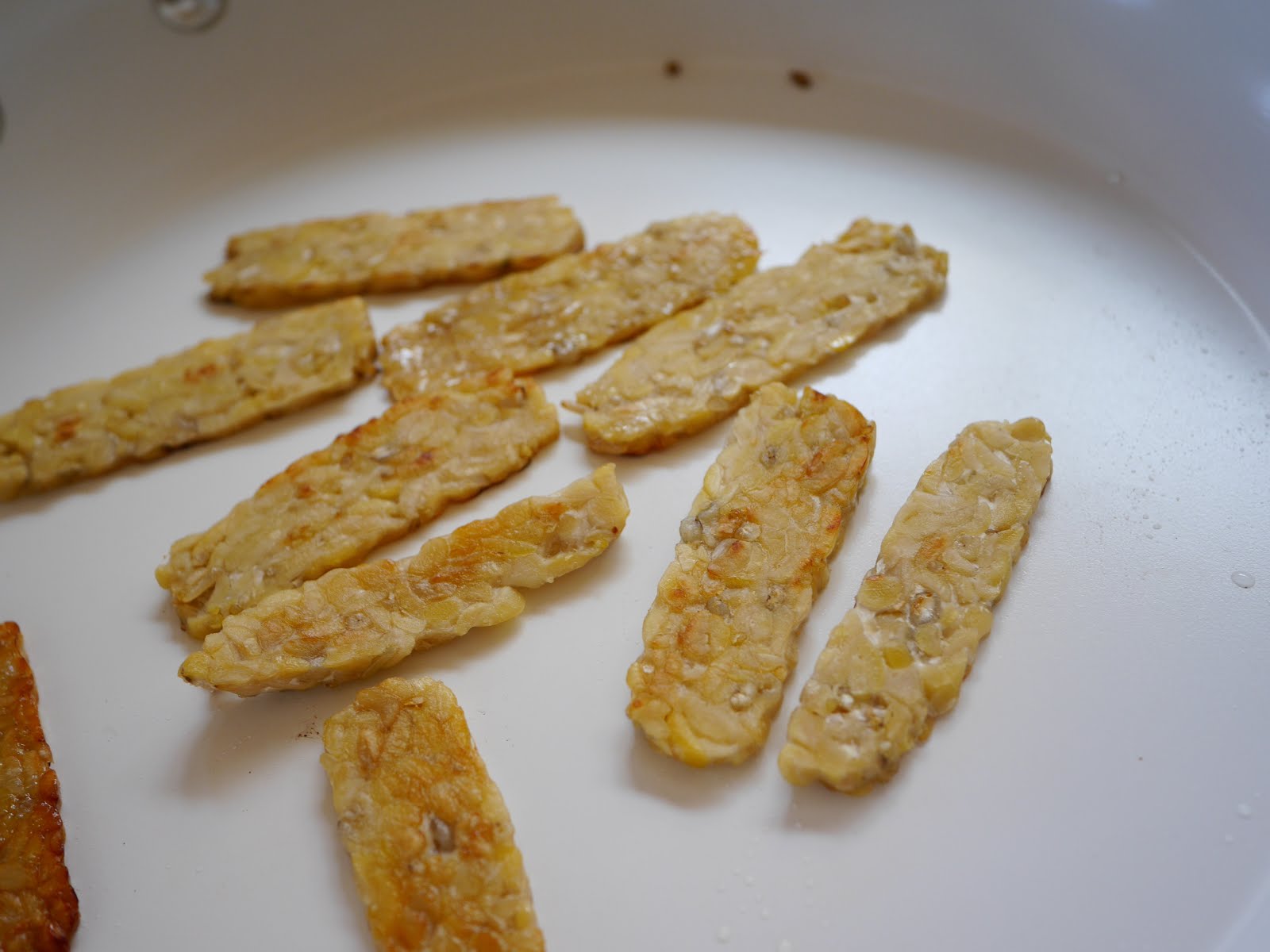


Remove from the pan and slice into small chunks. Set aside.

Add the remaining 2 teaspoons of oil to the pan. Add the ginger and garlic and cook on medium-low heat, stirring continually, until fragrant, about one minute or less. Add the onion, cabbage, carrot, mushrooms, soy sauce and rice vinegar to the pan. Stirring frequently, cook on medium heat until the vegetables soften and reach the desired texture. The mixture should be pretty dry.

Stir in the browned chunks of tempeh and cook until they are warmed up. Turn off and cover until ready to serve.


Wrap the tortillas in a towel and heat for 30 seconds to one minute in the microwave or heat individually in a heated pan. 

Place each tortilla on a plate and spread 1 teaspoon of plum sauce in the center.


Place moo shu vegetables on the center of the tortilla.


Fold and enjoy!


Creamy Asian Cabbage Salad With Black Sesame Seeds Featuring "Just Mayo" From Beyond Eggs

November 03, 2015 0
Raw cabbage is inexpensive, delicious and healthy!
And it's only 53 calories per serving!

Follow Foods For Long Life on Facebook and Pinterest.

Hampton Creek's Egg Replacer
Whether you eat eggs or not, there's something interesting brewing in the food industry. Hampton Creek, a fast-growing food company, is trying to develop food that is eco-friendly, compassionate, and healthy. And, of course, delicious - something many vegan food products are not. Their first target is to replace the egg.

They haven't come out will a product that will make scrambled eggs yet, although they are supposedly quite close, but they have developed a pretty delicious mayo substitute called "Just Mayo." 


Just Mayo comes in four flavors:
Original, Chipotle, Garlic, and Sriracha.

I'm not a big mayo eater but now and then you need a little bit for a creamy dressing like the one I'll share with you today. I'm also not terribly fond of vegan mayo because it doesn't have the taste or texture of real mayonnaise but this product really does. It's not that I totally exclude eggs from my diet. I'm lucky enough to have several friends who raise the happiest chickens on the planet. But when you buy regular mayonnaise, you can bet that the chickens that produce those eggs are from industrial farms and I don't like to support companies like that. 

What's in Just Mayo?
The ingredients include expeller-pressed non-GMO canola oil, while vinegar, and 2% or less of the following: organic sugar, salt, pea protein, spices, modified food starch, lemon juice concentrate, fruit and vegetable juice (color), and calcium disodium EDTA to preserve freshness. 

1 tablespoon provides:
90 calories
10 g total fat
1 g saturated fat (no trans fat)
Zero g of cholesterol 
80 mg sodium
Zero g carbohydrates, fiber, sugar, and protein

               *                           *                            *

My Favorite Cabbage Salad
There's a Japanese restaurant nearby that has the best cabbage salad. It's big and it's meant to share with the table but every time I go there, I eat an entire bowl or two of it. The last time I was there, I came home determined to make it myself. I think my recipe is a bit lighter (more vinegar, less mayo), but it's pretty darn close to what they serve at the restaurant. I'm excited to use Just Mayo as the base.

Besides being delicious, raw cabbage is extremely healthy to eat. First of all, it's a cruciferous vegetable which can help prevent cancers such as bladder, colon, and prostate but only if it's eaten raw or lightly cooked. Plus, it's a great source of dietary fiber, vitamin C, folate, potassium and manganese. It's also a good source of vitamin A, B6, thiamin, calcium, iron and magnesium. All this for one of the least expensive veggies you can find!

Creamy Asian Cabbage Salad with Black Sesame Seeds
Vegan, Gluten and Dairy Free
(makes 1/2 cup dressing)

Ingredients for the dressing
1/4 cup Just Mayo
1/4 cup Marukan organic seasoned rice vinegar
1 teaspoon grated fresh ginger
1 teaspoon pressed or grated fresh garlic
2 teaspoons black sesame seeds plus some for sprinkling

For the salad
1 to 2 cups very thinly sliced cabbage per person

Directions
To make the dressing, place the Just Mayo in a small bowl. Slowly stir in the rice vinegar and then the ginger, garlic and 2 teaspoons of the sesame seeds. I don't think it needs any salt but if you do, add a little pinch. There's already some in the mayo.

Place the cabbage in a large bowl and dress with the desired amount of dressing. To keep the calories low, start with 1 tablespoon of dressing per 1 1/2 to 2 cups of cabbage. Add more if needed. Sprinkle with a few extra black sesame seeds. Serve with chop sticks.


Nutrition
Per tablespoon of dressing: 53 calories, 5 g total fat, 0.5 g saturated fat, 0 mg cholesterol, 0 g protein, 1.5 g carbohydrates, 0 g dietary fiber, and 160 mg sodium. 

Per 1 1/2 cups of cabbage: 18 calories, 0 g total fat, 0 g saturated fat, 0 mg cholesterol, 1 g protein, 3 g carbohydrates, 1 g dietary fiber, and 9 mg sodium.

If you enjoyed this recipe, check out my eBook, Health Begins in the Kitchen.


Make Your Own SauerkrautLatin American Curtido KrautRecipe By Cynthia Lair

Juni 02, 2015 0
Cynthia Lair taught us how to make our own fermented foods.

Follow Foods For Long Life on Facebook and Pinterest.
Check out my eBook, Health Begins in the Kitchen.


Making Your Own Fermented Foods
Last week I wrote about the 5 Changes I Made Immediately After Attending the 2015 Health and Nutrition Conference.  The first one was to eat and make more fermented foods as it is one of the most important things you can do for your health.

Hands down, the most fun and entertaining presentation at the conference was by Cynthia Lair. I had never made sauerkraut before and, quite honestly, I was intimidated by the entire process. I pictured big ceramic crocks filled with smelly cabbage being pressed down with plates weighed down with rocks. But Cynthia's process was so easy I couldn't wait to try it.

Cynthia Lair
Watch her web cooking show,
cookusinterruptus.com

Latin American Curtido Kraut
by Cynthia Lair
Raw Vegan, Gluten and Dairy Free
Makes 4 to 6 cups

Requires 2 wide-mouth quart jars and 2 (1/2-pint) jars with lids.

Ingredients
1 (2-lb) head green cabbage, cored and thinly sliced*
4 teaspoons kosher salt
1 medium white onion, cut in half and thinly sliced
1 large or 2 medium carrots, grated on large holes
2 teaspoons dried oregano
1 tablespoon fresh oregano (optional)
2 jalapeno peppers, seeds removed, chopped finely

Note: The weight of the cabbage will determine the amount of salt. Cynthia recommends using 1 teaspoon of kosher salt for every 1/2 pound of whole cabbage. I love this recipe because it uses much less salt than other sauerkraut recipes.

Directions
Place the cabbage in a large bowl and toss with the salt. Set aside to "weep" while preparing the other vegetables. Do not add the other vegetables yet.

The salt will cause the cabbage to "weep" or release water.

With clean hands, begin massaging the cabbage with a firm grip. Continue for at least 3 minutes, working your way through all the cabbage. You will notice that the cabbage will already begin wilting and shrinking.

Cabbage after massage.

Now add the onion, carrot, and oregano and massage the vegetables together until they are well combined. Mix in the jalapeño with a large spoon.

Cabbage with other ingredients mixed in.

Divide the mixed vegetables among two wide-mouth quart jars, adding a little at a time and pushing down hard after each handful of vegetables goes in. You can push down with your fist or something like the pushing device of your Vitamix (that's what I used.) You can't hurt the vegetables with the forceful pressing. It will help them release water.

Push down the veggies hard.
  
Keep pushing down until the vegetables are submerged in their own brine. Add additional compression to the top of the mixture by placing a sealed 1/2-pint jar filled with water on top of the vegetables. I actually used 33 3/4 ounce Fido Jars as the fermentation vessel and sealed pint jars for additional compression. These Fido Jars have wider mouths to accommodate pint jars and they are great for storing the kraut when it's done.

Filled and capped jars add extra compression to the kraut.

Cover with a clean dish cloth to keep out the dust but allow in air. Keep the jars visible so that you visit them a few times the first day. It's important to keep the vegetables submerged in their brine so push down if they are not. Within 8 to 10 hours, there should be enough extracted liquid in the container to cover the veggies completely. After that, they'll only need a daily greeting and push.

Cover with a clean dish towel and visit each day.

Let the kraut percolate on the counter for at least 7 days to two weeks or more, depending on how tangy you like your kraut. When done, seal in a Fido jar and place in the refrigerator.
I placed my jars in shallow bowls since they will keep fermenting.

For those of you who think sauerkraut is only for topping hotdogs, you are in for a treat. I have been topping just about everything I eat with this wonderful Curtido. I especially like it on top of Beans and Greens.

Curtido Kraut on top of beans and kale.

A BIG thank you to Cynthia Lair for allowing me to share her wonderful recipe with you. Don't forget to check out her website and cookus*interruptus web cooking show.